Friday, November 1, 2013

The Acropolis of Athens, Part II

We walked back to the 50-some steps and entered the gate to the Propylaea.  This photo is taken from the point we climbed to near the Propylaea.
Athens sure is huge!

And this is a view of the Agora, north of the Acropolis.  And a wee portion of Athens beyond.

Zooming in, we get a nice view of the Temple of Hephaestus, the patron god of metalworking and craftsmanship.  Very well-preserved, the temple was completed in 416-415 b.c. 
Well, folks, that's as close as we're gonna get to the Temple of Hephaestus.  Enjoy the view!

As we panned to the south, it's a bird... it's a plane...

It's a...
DRONE!  Ok, in all honesty, I didn't know what this was, but Chris did, and he took pics of it.  We have no idea why a drone was flying around us and the Acropolis.  But it kinda scared me, since the only time we say the word "drone" in the U.S., it usually means something kinda scary.

Moving along...
We now pan back toward the Propylaea.  I never explained what the Propylaea is.  This is the monumental entrance gateway into the Acropolis. I found this drawing, courtesy of Wikipedia, showing what the Propylaea may have looked like in its prime.
Ummm...do you see all of those steps???

And this is what it looks like today (or at least what it looked like on June 10, 2013). 
Obviously, from this point, we still have numerous ramps and steps to climb.  (Did I tell you the Acropolis is WAYYY up there?)

Oh yeah, and remember that temple of Nike Athena?  This is the other side of it.  Remember creamy-color vs. white?
This temple was built between 427 and 424 b.c.  Sometimes you just have to stop and stare in awe at how incredibly ancient some of these structures are that we are standing right next to.  You can imagine people building them, visiting them, worshipping at them, abandoning them, and on and on.  A lot can happen in 25 centuries!

So we climbed those ramps and the last few (many) stairs.  And there we were. On top of the world!
Wow.  What an incredible view! We had to just stop for a moment and take it all in.

Turning back to the Propylaea, here is a close-up of some of the structure.  You can see that the columns are assembled, as with the Temple of Olympian Zeus, in modules, one on top of another.

I mentioned earlier that excavation and restoration is ongoing.  Here are some of the column modules.

There were signs asking that we not touch the columns, which we respected.

This view looks back at the Propylaea after we were inside the Acropolis.

Wait...what's that I see?  Is that...
 The Parthenon???

The Acropolis of Athens, Part I

By this time in our journey, approximately 14 hours after stepping foot off the airplane and onto Athenian ground, we had ogled the Parthenon from our rooftop dinner table at night, from the steps leading to the Panathenaic Stadium, from the Temple of Olympian Zeus, and from various other vantage points along the way.  I couldn't wait to go there!

Onto the bus we hopped, and we were taken on a 5- to 7-minute ride to the bus parking lot for "The Acropolis".  A word about "The Acropolis": we learned while we were in Greece that there is really no such thing as "The Acropolis", as we naive Americans have come to so endearingly refer to it.  In fact, for many of the cities and communities in Greece, each has its own acropolis. (I was going to phrase that differently, but I don't have any idea the plural form of "acropolis".)

You see, in Greek, "acropolis" means "highest city".  It is often a development in or near the center of the community, at a high elevation. "The Acropolis", which we refer to, is actually the "Acropolis of Athens". Contrary to popular thought, it does not consist only of the Parthenon.  It is truly a development of various components. And it is freakin' HUGE!  And it is wayyyyy up there.  Like, many steps up there.

So, we hopped off the bus and headed in the direction of the Acropolis (now, I'm just gonna abbreviate and not type Acropolis of Athens every time.  You know what I'm talking about.  We're in Athens.) And we walked around a corner and up oh, seven or eight steps, and into the woods on a path.  It was like a park.  Nice, wooded path.  This provided good shade on a hot day.

So we walked.  And soon we came to more steps.   So we walked up them.  And we walked.  

And we walked.

And we walked up.

And we walked up some more.

And we came to more steps.  And we climbed.

And we walked.

Up.

Some more.

You get the point.

We got to the entrance to the Acropolis and took a quick break for liquid refreshment (some water for us) and a quick restroom break.  During our break, Chris took this photo of the Philopappos Monument.  
This monument sits high atop Philopappos Hill, just under 1 kilometer to the west of the Acropolis.  The Philopappos is a monument and mausoleum dedicated to Gaius Julius Antiochus Epiphanes Philopappos (some prince dude who died in 116 a.d.). It is pretty cool and can be seen from most points in Athens.  That's about all I know about the monument or the prince.

So, we grabbed our cool Acropolis tickets and headed to the gates.  Whew, we were finally up there, after all that walking and all those steps.  Inside the gates, we walked forward and, guess what?  More steps.  Lots of them.  Like 50 or something. But we didn't climb them. Yet.

We took a detour to the right and hiked along another path, overlooking the city of Athens.
Looks a little smoggy, huh?

As we wound along the path, we came upon this.
The Odeum of Herodes Atticus.  This is a working theater, and as you can see, they are preparing for an opera to be performed later that week.  During the summer, there are weekly musical events in this theater.

 This amphitheater, with its near-perfect acoustics may be best known in modern times as the location of Yanni's 1993 performance and audio/video recording "Live at the Acropolis" (which, by the way, is very cool to listen to as I type this blog).

The backdrop stands in ruins, which makes it very cool that it is currently used for performances.  I'd love to see anything there.  Originally, there was a cedar roof, which is now long gone.

Other famous performances include Sting (sigh) on his Mercury Falling tour in 1996, Elton John times 2 during his 2000 Medusa tour (I wonder if he shuffled across the stage like he did in the Red Piano when I saw him in Vegas in 2007?), and Andrea Bocelli in 2010.
Part of the upcoming opera.  Spooky...scary!

A couple of additional photos of the Philopappos Monument from this perspective.

We have several pictures of the monument.  It must have really intrigued us.

This is the Temple of Athena Nike.
We will get to see more of it in a few minutes.  But for now, do you notice the creamy-colored stone and the white "stone"?  The Acropolis is under restoration and has been for several years.  Anything you see that is white is "new".  The creamy-colored stone is the original stone.  The process for restoring the Acropolis is very cool.  They are still excavating and finding pieces of the original Acropolis.  It's like a giant life-sized jigsaw puzzle.  And when there's a missing piece, they just make one!

We'll see more of the contrasting materials in later photos.  But for now, remember those 50-ish steps?  Let's go climb them.  (The Parthenon has to be around here somewhere, and I'd really like to go there one day...)

Saturday, October 26, 2013

Temple of Olympian Zeus

After exploring the Panathenaic Stadium, we were off to a little place just around the corner.  It was the Temple of Olympian Zeus.
You can tell it's basically just an area of dusty land with a handful of columns.  Right?

Um...not exactly.

This happens to be the second of two temples constructed in dedication to Zeus, the king of the Olympian gods.  Construction on this second temple began in 520 B.C. but work was abandoned and restarted under several regimes and due to several battles over the years, and was not completed and formally dedicated until 132 A.D.  By this time, Athens was under the rule of the Roman Emporer Hadrian, who built the Arch of Hadrian at the entrance to the temple grounds.

(credit: Wikipedia)

The design was also changed a few times during construction.  The final plan consisted of 3 rows of 8 columns across the front and back, and a double row of 20 columns on the sides, for a total of 104 columns. 

In the 3rd century A.D. and periods after, the structure of the temple, was pillaged and its marble and other building materials were harvested for for use in construction all over Athens.

Columns are of the Corinthian order (the first time this order was used on the exterior of a major temple - there's your trivia for today!), standing 17 meters (55.5 feet) high and 2 meters (6.5 feet) in diameter.

It's really hard to get an idea of how large this temple ruin really is.  So here's a picture of me standing in front of the columns, for scale.  Huge!


Walking those grounds, I openly wondered to Chris why we (people in general) allow something so majestic and beautiful as this temple to be pillaged and ultimately stand in ruins.  Our discussions brought me to the realization that the lack of preservation is largely due to the changes in religious and political majorities in the region over the years.  When the temple was built, the Olympian gods were very important to the people of Athens.  In later years, Christianity reigned, and worship of Roman and Greek gods was prohibited.  Without that societal influence (wow, I'm using some big words!), the temple lost its significance.  An interesting phenomenon, huh?  Who knew centuries ago that people of all religious affiliations of the 21st century would explore these grounds in wonder and amazement, just of the art and architecture involved in the construction.  To us, the religious and political connotations do not factor into our sense of wonder.  However, I think the amount of time that has passed does play a role.  I can't imagine looking at a temple honoring, say, Adolf Hitler, with the same level of amazement and appreciation, regardless of its artistic or architectural value.  Interesting to think about, right?


That's the acropolis beyond the Temple of Zeus (I'd like to go there one day...).  It sure looks like it is right there, doesn't it.  You could reach out and touch it. It's actually about a half a mile away, as the crow flies.

At the Temple of Olympian Zeus today, 15 columns remain standing, and a 16th one is lying across the ground.  This column was toppled by the strong wind of an 1852 storm. Here, you can see that toppled column.


After our visit to the Olympian Temple of Zeus, it was back to the bus, and we were headed to our next stop, which was the "pinnacle" of our city tour.

Thursday, July 18, 2013

The Panathenaic Stadium

As I mentioned earlier, we used a travel agent to help us book the airfare, airport transfers, hotels and a tour while in Athens.  She priced packages through a couple of companies, and ended up booking through Avanti Destinations. We were pleased with this, since we had successfully used Avanti for our London package in 2012.

Avanti contracts with Conceptours in Athens. We were scheduled to meet at 9:30am for our walking city tour of Athens, but when we had arrived at our hotel the night before, we had a note waiting for us saying we would be picked up from the hotel lobby at 8:15am.  That was it.  No explanation. No phone number.  So we thought maybe they were starting the tour early.  Why else would they move our start time up 1 hour and 15 minutes?

Well, I guess we're gonna get adjusted to the new time zone in a quick way!  We were up Monday morning, June 10 at 7am, giving us just enough time to shower, (re)pack, check out and check our luggage with the bellman, and grab a quick pastry and piece of toast from the fabulous breakfast buffet that was included with our hotel rate.  We were sad to miss that, but little did we know, we had many fabulous breakfasts ahead of us!

A tour hostess met us, with a few other families, in the lobby and walked us a few blocks down the street and around the corner to...

a bus!

Yep, they had "upgraded" our walking tour to a nice, air-conditioned bus tour.  Now, walking would have been fine with either of us, but we weren't complaining about the swanky bus accommodations. And by the end of the tour, we realized how wonderful it was to have that bus!

Our tour guide was Acimenia (my best guess at the spelling), and our driver was Serafin.  We giggled a little about how Acimenia (and the tour itself) reminded us of the movie My Life in Ruins, which we had bought and watched before our trip. (Cute movie starring Nia Vardalos, by the way.  I recommend watching it, but once is enough.)

Our first stop was the Panathenaic Stadium.  This is  the stadium constructed to host the first modern Olympics in 1896. 
 
The stadium was built on the site of an ancient stadium that was used for the Panathenaic Games (thus, the name).  Those games were hosted every four years, dating back to 566 B.C. (That's B.C., Y'all!  As in two thousand five hundred seventy-nine years ago!!) Sometimes it is hard to believe that we were standing in a place with such a long - and grand - history.

Those Panathenaic Games, were similar to the modern Oympics, except that they were not all about athletics.  While they included several sports, they also included a religious festival, cultural events, and competitions in literature and the arts.  These Games lasted until the third century A.D.

At one time, the stadium seated 80,000 spectators. The current structure can seat 45,000.  Maybe they just chopped it off at the front there?  Or maybe the risers went even higher than they do today?  Nobody told us, so that will have to remain one of the mysteries of Ancient Greece.


The obvious question is: how was this stadium used in the 2004 Athens Olympics?  Well, here's your answer: it was used for the archery competition and the finish line for the marathon.  We were told that currently, it serves as the start/finish line for many annual races, including marathons.

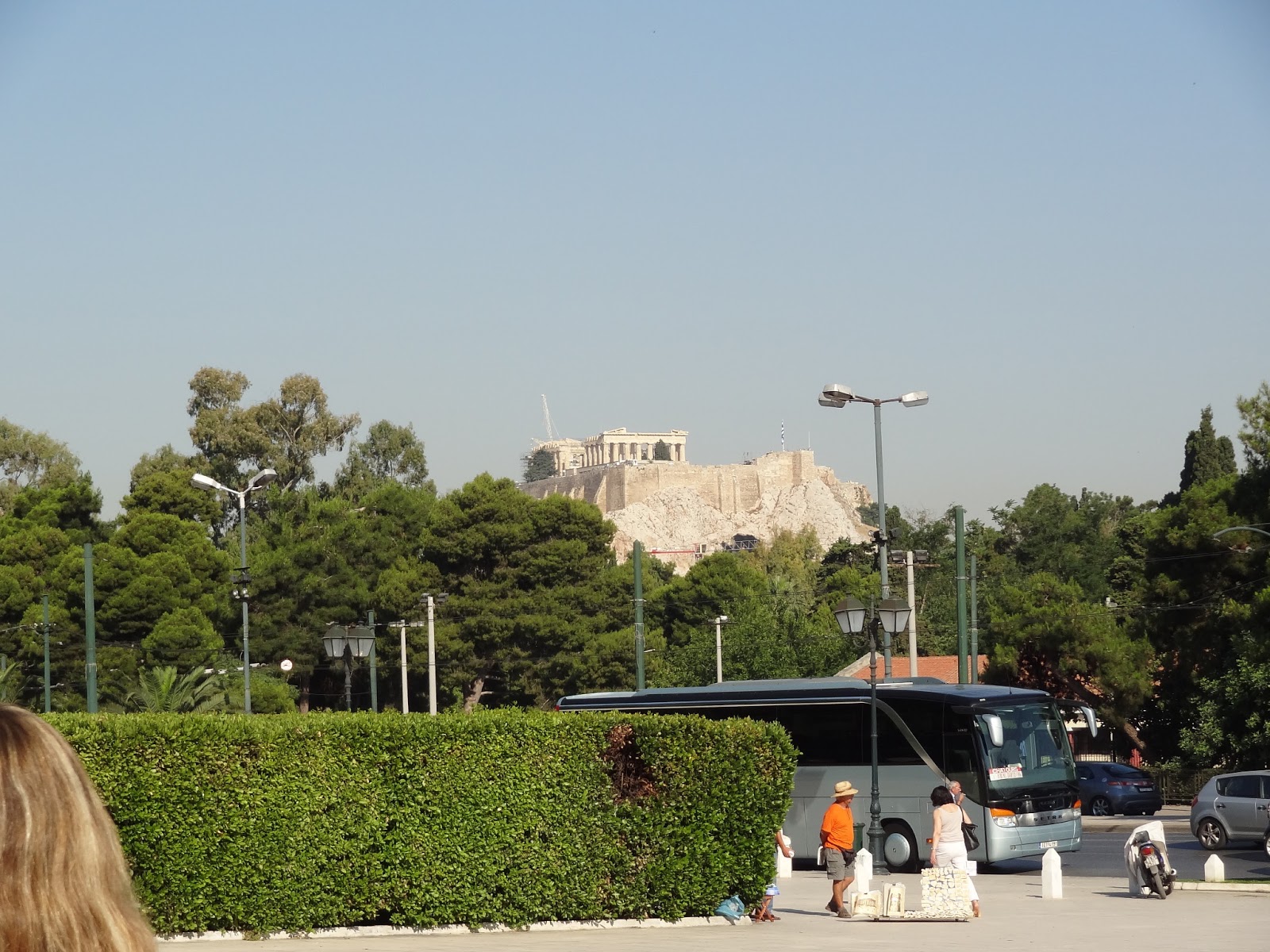
As with most locations in Athens, we could see the Acropolis from the front of the Panathenaic Stadium.
 "Hats...hats...get your American-style baseball caps, screenprinted with 'Athens' here..."

Add a little zoom...
Oh! There's a shot of our tour bus!  Looks cool and comfortable, doesn't it?

Our little camera has a decent zoom on it. And clearly we were fascinated by the Acropolis.
 I'd really love to go there some day...


Thursday, July 11, 2013

An American in Athens (Well, TWO Americans in Athens - Maybe More!)

Our hotel for the first night was the Electra Palace Hotel, located in the Plaka area of Athens. The Plaka is the central, tourist-y area of Athens.  This hotel is one of the nicest in the Plaka, rated at 5 stars on Trip Advisor, and ranked #12 of 289 in Athens on that same site.

Here's a map showing the location of the hotel in relation to the Acropolis and other Athens landmarks:


The hotel is at point "A".  To the West, you can see the Acropolis.  To the South, the Temple of Zeus, and to the far Southeast, the Olympic Stadium.  We will visit these tomorrow.

The hotel was lovely, with an American-style king bed, a balcony (overlooking a courtyard - nothing to write home about), and a large bathroom and closet.  Our room was right next to the elevator - very convenient.  There were also beautiful marble stairs next to the elevators, which we preferred when we weren't toting luggage.

We unpacked and freshened up quickly, then visited the front desk staff (they didn't have a concierge, at least not that we saw) for help with a few items: dinner recommendation, a place to buy toothpaste (which we had forgotten), a place to buy a cell phone, and they helped us break our large bill Euros into more manageable ones.

A side note about money in Greece.  We all know about Greece's economic troubles.  We have also heard about how, in March of this year, the government of Cyprus seized up to 40% of money held in private bank accounts in their country.  Because Cyprus is geographically so close to Greece, and Greece is experiencing similar economic troubles, business owners in Greece are a bit leery about the banks.  And it is currently taking 60+ days to collect customer credit card charges from the banks.  For this reason, we found that most tavernas, shops, and restaurants would not take any credit cards, even if they advertised that they did. They were pretty blunt about saying "we don't trust the banks."  It was not a huge hassle for us, as we took our budgeted amount for food, groceries and souvenirs in cash, but it's good to know if you plan to travel to Greece any time in the near future.

We were hungry!  It was after 8:30pm by this time, so we ventured in the general direction in which the wonderful staff at the hotel had directed us. Many of the roads in Athens do not have names.  So the directions go something like this: go out of the hotel.  Take a right.  Then walk "a good bit" and pass two streets then take another right.  Walk "a little more" and look for "some steps on the left".  Go up the stairs and find ____ _____ (a bunch of Greek words that we didn't understand or know now to spell, using either the Greek or the English alphabet!). So yeah, you could say we just winged it, and looked for "some steps on the left".

If you scroll back up to my map above, and pretend you're walking West from the hotel, you'll see that there is soon a "Y" in the road.  Our wonderful desk staff (and yes, they were wonderful - on par with Four Seasons or Ritz) had left that part out.  The Y.  So we had no idea what to do and just took a risk.

The walk was lovely.  The weather was nice and the sights were uniquely Athenian.  It was exhilarating to both of us being in ATHENS of all places! So we held hands and enjoyed the walk.

Eventually, we found "the steps on the left".  It must have been the right place, because, although there were plenty of steps in the Plaka, and in fact, plenty  of "steps on the left", we found the steps with lots of tavernas on either side of them.  It was really beautiful.  Here is a daylight photo from the next day, as I don't have one from that evening:

I couldn't even count the number of tavernas and cafes on either side, and they went wayyyy up a hill there.  Many of them had both tables and pillows (where you could sit directly on the steps) outside, and most of them had inside areas also, but they were not air-conditioned.

Something else we learned on the trip.  In Greece, there are three main types of eateries, and it helps to know what to expect at each one:
- Cafes are basically coffee shops.  You can get coffee, tea, water, juice and soft drinks.  Food offerings are typically pastries and club sandwiches.
- Tavernas are classic Greek diners.  They are usually owner-operated and serve classic Greek fare (Greek salad - AKA "Country salad", calimari, fresh fish with head-on, shrimp dishes, some pasta, etc.)
- Restaurants are much like American restaurants, with full menus and a large variety.  

Also, for what it's worth, don't bother asking for hummus. I guess I'm an idiot, because I thought I was going to eat a lot of hummus in Greece.  We asked at our first couple of tavernas, and got "the look".  I am not sure what "the look" is, but it means "we don't have hummus lady, are you nuts?"  That's ok, because it didn't take me long to discover that spicy cheese dip with warm pita wedges is wayyy  better than hummus.

So, we looked for the name of the taverna our hotel staff had directed us to, but we couldn't read the Greek alphabet and couldn't tell if anything looked anything like what we were looking for.  So naturally, we did what (apparently) every American in Athens does, and walked to the last taverna at the very top of the steps.  We were escorted to the roof and told to sit where we want to.  We picked a nice table along the front side of the roof garden, overlooking "the steps on the left", which were now no longer on the left, but I digress.  We chose to both sit on one side of the table.  I'll show you why.

This was our view of the roof garden taverna:
Neat, huh?  But that's not why we sat where we did.

This was why:

Ladies and gentlemen, I present to you: The Acropolis!!  We were amazed that we were having dinner just below it.


I also took a picture of the city of Athens from the rooftop, but it's not as impressive as the Acropolis side.

You can tell the sun was still setting.  My camera wasn't set for night shots, and it is not as foggy as it appears here.  Athens really sprawls out very widely.  It is a huge city.

I mentioned before that apparently every American in Athens chooses this restaurant.  It was not crowded, but we did notice that the people at every table around us spoke English with American accents.  I had fun playing a little "guess where they're from" game in my head.  The table to our right was four businessmen who I had pegged for either Californian or mid-Atlantic.  Turns out they were from Seattle, Oregon and central Florida. 

The couple to our right was a little easier.  We pegged them as being from Jersey, which they were.  We did the American thing and took pictures of them together under the Acropolis. Told a few stories, had a few laughs, and then asked the waiter to cork up our wine bottle to take with us.

We took our wine back to our room, knowing that the rest of the trip was by bus and boat, so we could save this wine and drink it later.


(P.S. I don't think we ever finished it.)

And it's off to sleep after a long two days of travel and a nice meal with a beautiful view.  Our first night couldn't have been better!

Wednesday, July 10, 2013

The Road to Athens (In The Air)

When planning our trip, we first selected our flotilla route (Saronic), length (14-day) and dates (June 10-24, to coincide with Chris's business associates' - and now our friends' - chosen holiday dates). Next, we had to determine how to get from Austin to Athens.  I researched flights and narrowed it down to either British Airways/American or Air France/United, in order to get the most efficient and cost-effective routes.

As with a cruise, we wanted to get to Athens a day earlier than our flotilla departure, just in case there were any delays that could cause us to miss our Sailing Holidays coach on Monday the 10th.  (As it turned out, this was a good idea, since our flight to Athens on the 9th was delayed a couple of hours.)

We left Austin on Saturday the 8th at 2:30pm, flying American to Dallas.  There, we met our transatlantic chariot.
Our first ever flight on a 747!

I worked with a travel agent and was able to use our American Express points to upgrade us to Business Class for the voyage.  Business Class includes the following:

- First Class on US domestic flights
- Access to airport business lounges prior to flights
- Priority boarding
- For the transatlantic flight, fully reclining (180 degrees) seats, with a pillow and quilt
- Champagne before departure, 4-course in-flight meal, a second meal (breakfast or tea, depending on time of day), unlimited cocktails in lounges and in flight, and a "kitchen cafe" while in flight where we could help ourselves to fruits, small sandwiches, ice cream, etc. (transatlantic flight)
- Unlimited movies from a selection of over 100, television, and noise-canceling headphones (transatlantic)
- Amenities kit (toothbrush and toothpaste, cleansers, toners and moisturizers, and "flight socks") (transatlantic)
- Complimentary 15-minute back massage or facial at Heathrow upon arrival

Our seats for the transatlantic faced each other with a little divider screen between us, which we left in the "down" position.
Oh, to be honest, these weren't our seats.  They were the ones in front of ours, since we had already settled into our seats when I decided to snap a photo.  But ours looked just like these! (Imagine that!) It was a pretty cool set-up. And as comfortable as I suppose you can get on an airplane.

We left Dallas at 6:45pm and arrived Heathrow at around 9am local time.  There, we visited the "Galleries" lounge and used our amenities kits to freshen up and grabbed a bite to eat.  Then we had a full lunch at a pub in the airport.

Our flight to Athens was delayed about 90 minutes, finally departing around 2pm and arriving Athens close to 7pm (we lost 2 hours on that leg).

Our travel agent had put together a package that provided all of our airport transfers (we needed 4 for the trip), our hotels for the nights before and after the flotilla, and a tour of Athens.

Our driver, George, met us at the airport and loaded us into his taxi.  On the way to our hotel, he gave us some good tourist information, and talked about the economy in Greece in general, as well as how they LOVE American tourists for a variety of reasons.  We are helping their economy, we tip (even though we aren't supposed to - our culture is accustomed to it and it's a hard habit to break), and Americans are enchanted by Greek culture, architecture, and food.

The drive was about 30 minutes, and George pointed out several prominent landmarks along the way.  In what seemed like no time, he was dropping us off at our first night's hotel.

Next, did the jet lag get to us?  How was the hotel? And most important, did we see the Parthenon?
   

Monday, July 8, 2013

Our Boat for the Flotilla

When we booked our flotilla trip, we had to select our boat.  We had selected the Beneteau 311 (smallest boat for that flotilla), but there were none available, so we were assigned a Beneteau 331.

The boat is 33 feet, 11 inches long.  Will sleep 6, but was quite comfortable for the two of us.  You could probably add another two and do fine, but it would be tight with 6.

Our boat was named Konitsa, which is a town in northern Greece, near the Albanian border. Here we are on Day 2, getting ready for our first on-water voyage.


Chris demonstrating the plank, used almost daily for the Mediterranean-style mooring (stern-to). (This photo was taken in Poros.)
 
Sailing Holidays has a nice introduction and description of the boat here. Wait.  Maybe I'm supposed to be referring to it as a "yacht".  I am not very good with all of my sailing terminology.

Here is a video of a Beneteau 331 that is offered for sale. It gives a good idea of the layout of the boat. 

And a diagram of the "floorplan".
 We had two fresh water tanks, and two showers (one in the head and the other on the back of the boat). We used these sometimes to bathe, but more often than not, we showered at tavernas and hotels on land.

You are warned against drinking ANY water in Greece, and bottled water is very inexpensive (1 liter for 50c Euro, for example).  So we kept a stock of bottled water to stay hydrated and to brush our teeth.

As with all boats with a "head", there was a holding tank.  We were instructed that nothing goes into the toilet that didn't go through our bodies.  This is also applicable on land throughout Greece (at least all of the places we visited, including Athens).  It took a little adjusting to, but we made it just fine!

We were supplied with two sets of linens, two beach towels, dish towels, and cleaning supplies.  Keep in mind that in Europe, they don't use what we Americans refer to as "wash cloths" (and the British refer to as "flannels"), so we had to improvise there, in order to maintain the comforts of home, if you know what I mean...

On the boat were also: 6 cockpit cushions, a set of binoculars, all the nautical navigation charts and tools we would need for the trip, a radio/CD player, a VHF radio, all the necessary safety equipment (harnesses, PFDs, fire extinguishers, a fire blanket, first aid kit, tool kit, etc.), extra containers of fuel and fresh water, and an inflatable dinghy.  For an extra 85 Euro, we rented an outboard for our dinghy for the two weeks, and it came in quite handy.

All in all, we felt like the boat was well-equipped, and it was VERY clean - felt almost like brand new!